 038-4270410


Previous Story
Two denominations, one building, one hope and future
Posted On 27 mei 2026
Comment: 0
The white Reformed Church in Pretoria West is shrinking. But a black congregation also meets in the same building, and it is growing.
This is the story of two churches in South Africa that no longer allow themselves to be defined by culture, language or history.
It is Sunday morning. Reverend Desmond Magayisa is standing at the door at eight o’clock sharp. He exudes the calm of someone who knows that rushing rarely helps, yet still wants to be on time.
We drive to Pretoria West, to a church built in 1951 for a white African community that was still growing at the time. Now it is shrinking.
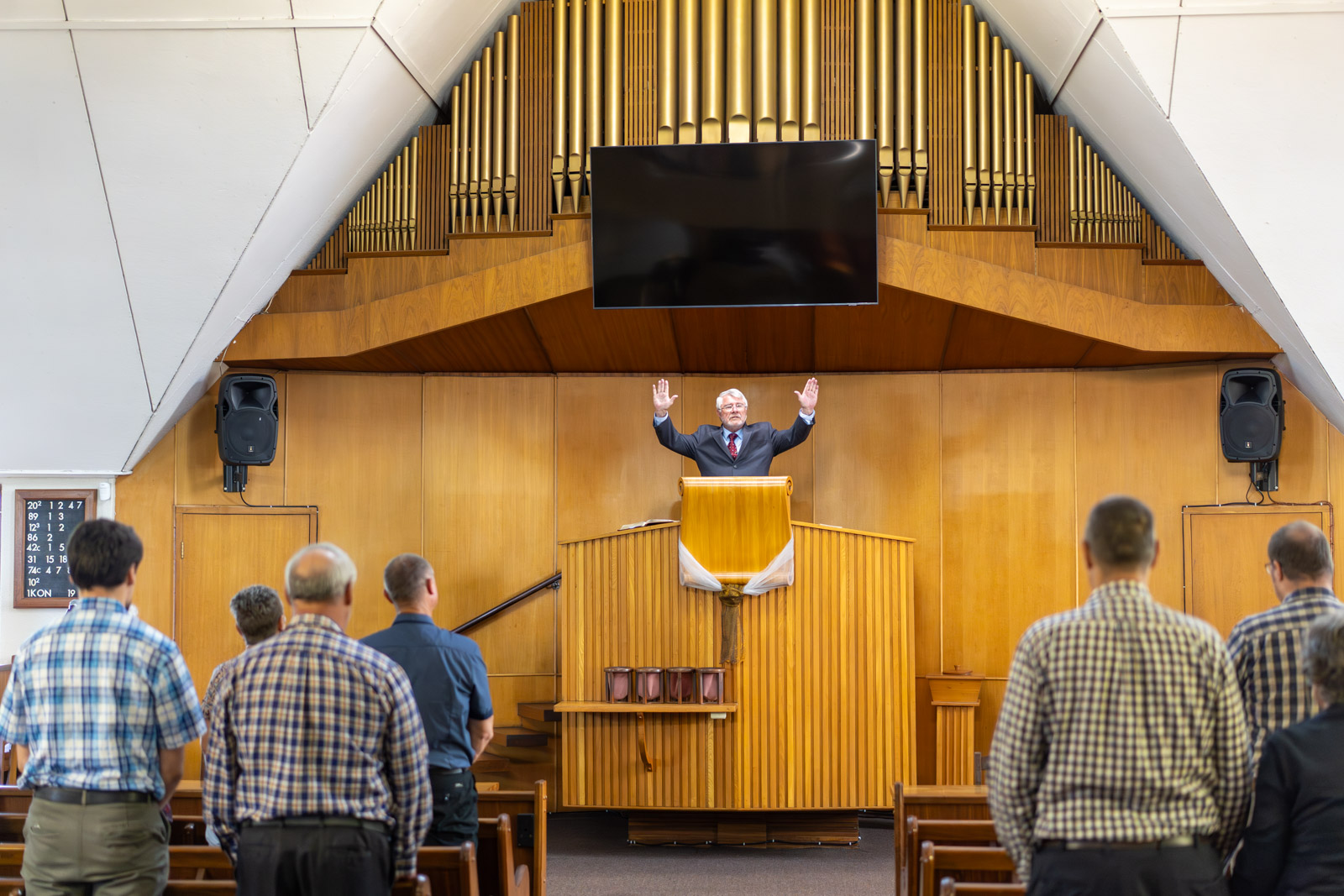
History breathes through the walls, but the future is already knocking softly against them. Two services are now held in the same church. At nine o’clock, the Afrikaans service for an ageing, white congregation, part of the Reformed Church (also known as the Dopperkerken). Then, at eleven o’clock, the English-language service for a growing Black congregation. Two worlds under one roof, each with its own rhythm, but sustained by the same God.
‘It feels like family’
On entering, I am greeted with a warm: ‘Baie welkom, ons is bly jy is hier.’ My Dutch is understood perfectly here.
Lourens Beste – known as Louw for years – is eighty, almost as old as the church building that is so dear to him. He says this without pride, but with a smile that betrays the fact that he finds it special himself. His Bettie, his ‘angel’, stands beside him. She calls him her ‘dearest’. They have been coming here for decades. Their children grew up in this church.
The congregation has grown smaller, and older too. But the loyalty has remained. ‘It feels like family,’ says Louw. ‘We look out for one another.’ And, almost in passing: ‘We’re glad that Reverend Desmond holds the English-language services here. His congregation is growing. That gives this building a future.’
Just like in the old days
In the African service at nine o’clock, everything seems to be proceeding exactly as it did eighty years ago. Psalms are sung; the organ provides the accompaniment. The average age is high. The atmosphere is friendly and subdued – an inward-looking, yet safe place.
Afterwards, Elsa Steynberg carefully descends the stairs to the organ, assisted by another congregation member. She has been playing the organ here since she was eighteen. She knows the stairs like no other. Cancer and neuropathy have taken their toll on her body, but not on her spirit. She smiles as she descends carefully and slowly. It takes effort, but it is worth it to her.
Over coffee – with cake, as there is a guest today – the love for this place is palpable.
A parishioner proudly points to the freshly painted walls. ‘We want to leave it looking nice,’ he says. ‘When we stop, Reverend Desmond’s congregation can carry on here.’
There is sadness in those words, but also something grand. A kind of faith that does not cling on, but passes on. The decline is palpable, but not bitter. Gratitude prevails.
A service that dances
The English-language service begins at eleven o’clock. People continue to trickle in after eleven, but nobody seems to mind. The atmosphere is open, fresh, full of anticipation. Reverend Desmond plays the electric piano, his wife sings.
The sermon is about joy amidst hardship. About pain, which does not have the last word. About God’s plans, which are greater than our worries. It sounds simple, but it resonates.
The congregation sings standing up, dances after the collection and moves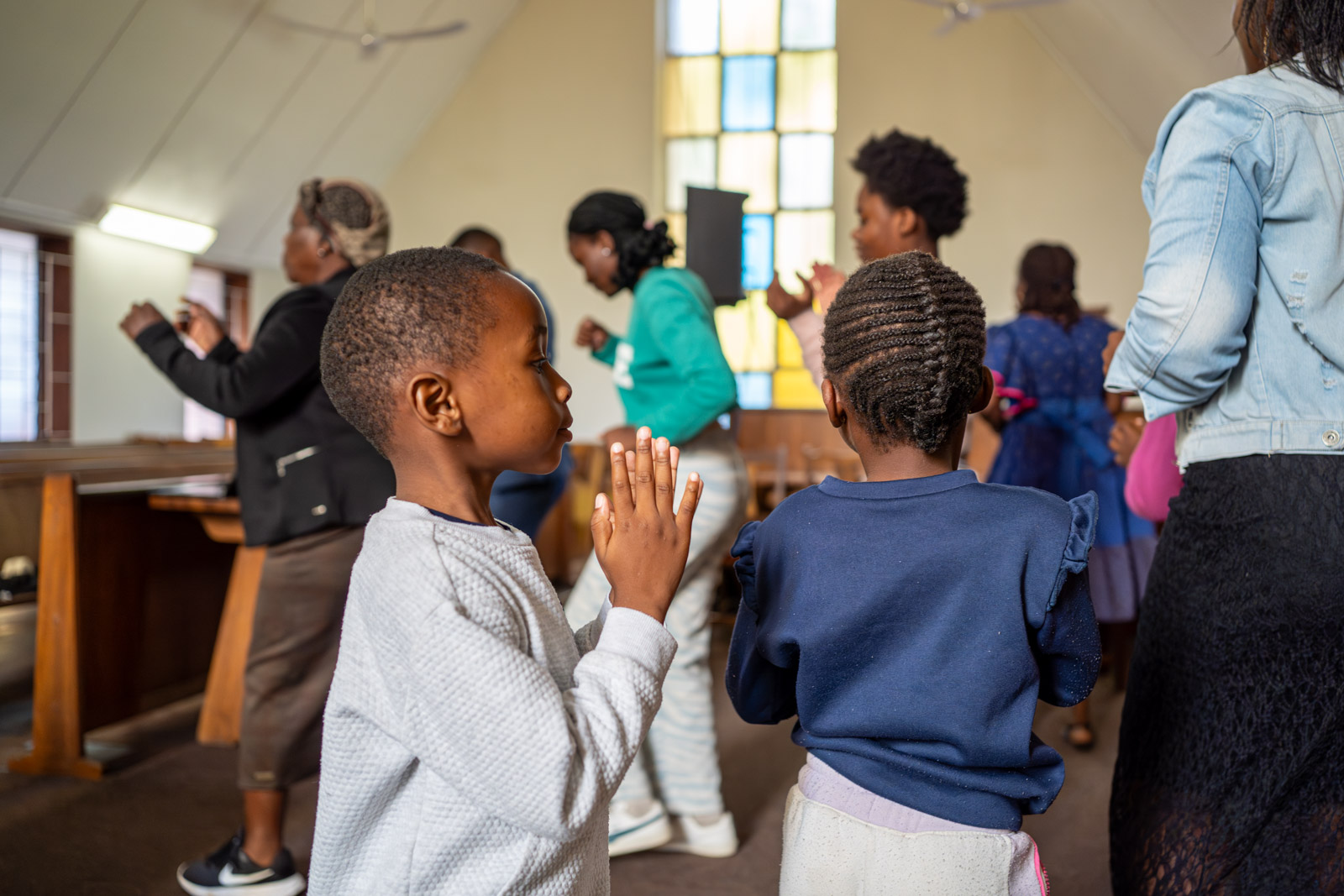 without hesitation. Armanda Mogotsi, aged 67, sits praying with open hands. She is divorced and has a son. Her father used to be an evangelist in the Dopper churches. His name was Johannes Japie Molefe. She beams when she talks about him.
In 2022, she was the first, along with eight others, to come to this church. ‘This congregation feels like family,’ she says. ‘We look after one another.’ And she does the same for people outside the church: she goes out onto the streets to talk to people and pray for them.
Behind the projector sits Wanga Tshikovhi, aged 21. A film student with dreams for the future. Before she came to this church, she used to go with her parents to see a prosperity preacher. Many people in Africa want to see spectacular miracles, often in exchange for payment. Bizarre things happened. She lost her trust, her faith, almost herself. She ran into problems at home and at school. Until a friend took her to this congregation. Now she comes here every week. She was baptised in December. ‘I feel at home here,’ she says. ‘I’m growing here.’ Her parents see it too. Reverend Desmond is helping to restore her relationship with her parents. Whilst many people are looking for spectacular miracles, here they see something else as the great miracle: a change of heart.
Reverend Desmond explains how the congregation almost buckled under the weight of its own generosity. They wanted to help everyone, including financially with funerals – which cost a lot of money; people often receive support from friends, and the church wanted to step in as well.
But the need was greater than their capacity. ‘We prayed for wisdom,’ he says. Galatians 6:10 provided direction: do good to everyone, but first to one’s own faith community. Not as a restriction, but as a framework. It worked. People joined the church. Engagement grew. The church grew. A balance was struck between caring for those within and those outside.
For church members, there are leadership training courses, Bible studies, and discussions with young people about drugs, alcohol, sexuality and social media. For the neighbourhood, there are sports activities, after-school care and online Bible studies.
Something new
Some shrinking churches in South Africa sell their church buildings and cease to exist. Here, the shrinking congregation chose a different path. They asked Reverend Desmond to start a mission church for the growing black community in Pretoria West. So here, history and the future do not stand in opposition to one another. They sit side by side, in the same church. On the same Sunday. One congregation preserves a history; the other builds towards what is to come. And somewhere in the middle, something new emerges.
Decline and growth, pain and dance, farewell and growth – you find them in two services, under one roof of one church. On an ordinary Sunday in Pretoria West.
A city changing colour
The Reformed Church in South Africa (GKSA) was founded in 1859 as a breakaway from the Dutch Reformed Church. The congregation of Pretoria West was founded in 1945; the church building dates from 1951. In recent years, the demographic makeup of this part of the South African capital has changed: many white residents have left, whilst many black South Africans have moved in. The congregation then called Desmond Magayisa as a missionary to establish a new church. He is married and the father of three young children. At present, Reverend Desmond still falls under the church council of Pretoria-Wes. Work is underway to form a separate church council, so that the new congregation can eventually stand on its own two feet. A number of prospective church council members are currently serving on the white church council. In this way, a new church is gradually emerging from the shrinking GKSA congregation.
Marjan van der Lingen, member of CRB
